



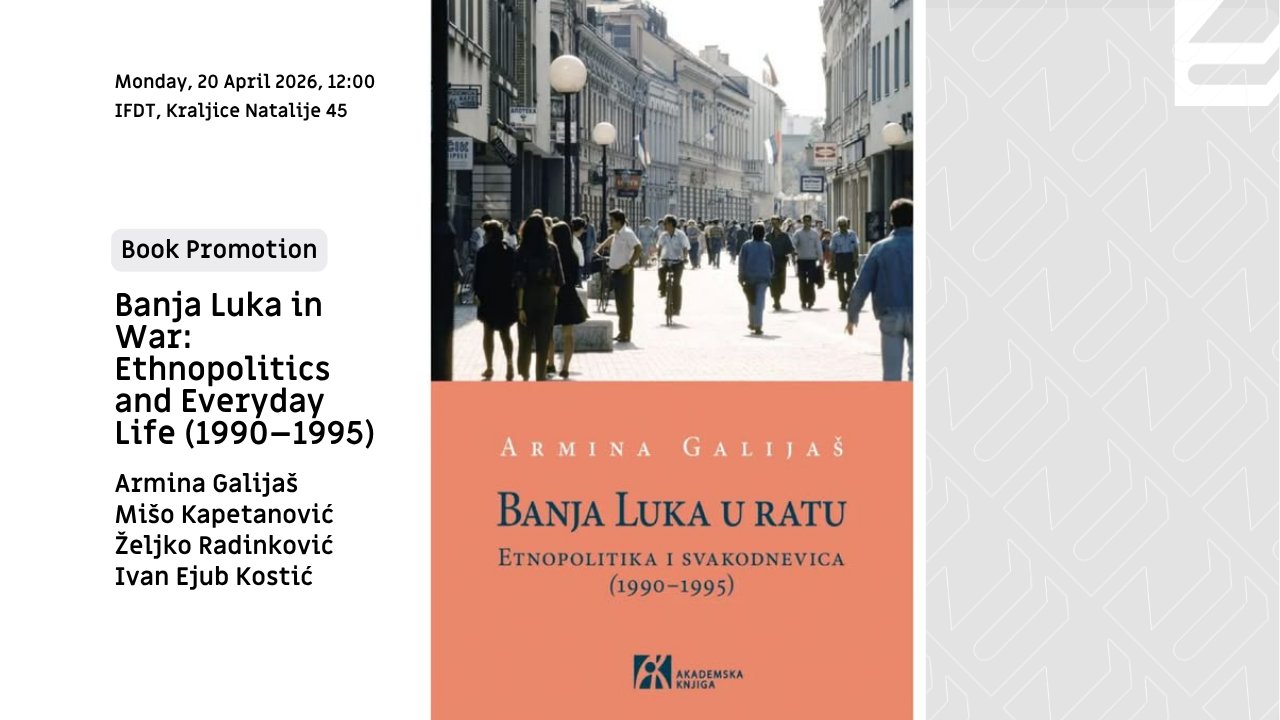
[Book Promotion] Banja Luka in War: Ethnopolitics and Everyday Life (1990–1995) (ActiveLab, YugoLab)
The Institute for Philosophy and Social Theory and Oštra Nula are organizing the promotion of the book Banja Luka in War: Ethnopolitics and Everyday Life (1990–1995) by Armina Galijaš, which will take place on 20 April at 12:00 at the Institute (Kraljice Natalije 45, Belgrade).
This is the first academically grounded and systematic study dealing with the war in Banja Luka, focusing on ethnopolitical processes and everyday life in the period 1990–1995. The book analyzes how political, institutional, and social practices shaped the experience of war in a city that has long remained outside dominant narratives about the war in Bosnia and Herzegovina.
In wartime Banja Luka, the ethnopolitics of the authorities reshaped the city’s demography, everyday life, identity, and urban structure. The author carefully traces the emergence and imposition of an “ethnic matrix” through media, education, culture, language, and toponyms, as well as through religious and state rituals. Particular attention is given to discriminatory policies such as “job equalization” and “housing rationalization,” which had direct consequences for the population. Social stigmatization, administrative measures, propaganda, and targeted violence, supported by key social institutions, led to the exodus of the non-Serb population. Based on extensive historical sources, the book systematically maps, for the first time, the “invisible war” that, even without direct combat, permanently transformed the city.
In the broader context of contemporary global polycrises and the resurgence of exclusionary political discourses, this study offers an important analytical framework for understanding subtle transformations of power and their long-term consequences.
The speakers will include the author Armina Galijaš, the translator Mišo Kapetanović, and researcher Željko Radinković (IFDT). The discussion will be moderated by Ivan Ejub Kostić (IFDT).
Armina Galijaš is a historian specializing in contemporary Southeast European history, with a focus on Bosnia and Herzegovina, Serbia, and Croatia. She is based at the University of Graz, where she conducts research on the wars of the 1990s, post-war transformations, nationalism, memory culture, and everyday life. She is the author of numerous academic publications and an active participant in international research projects.