



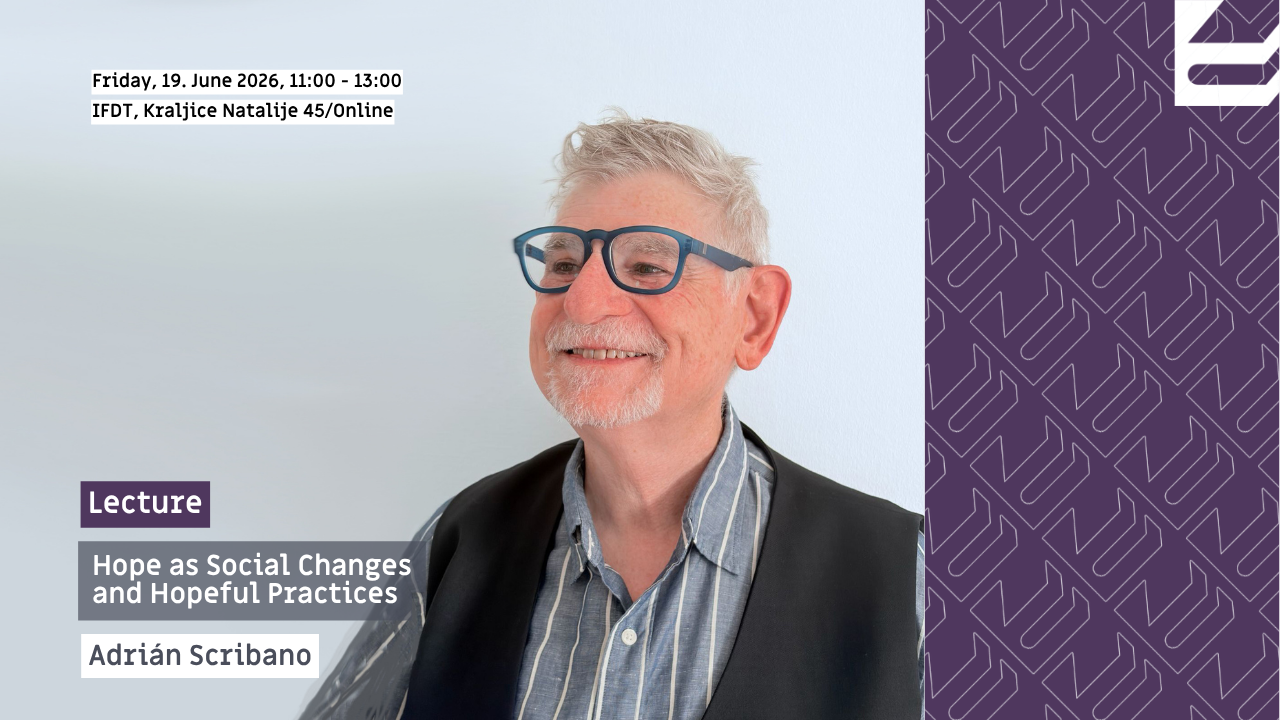
[Lecture] Hope as Social Changes and Hopeful Practices (CriticLab)
Adrián Scribano – Hope as Social Changes and Hopeful Practices
In a context where the planet seems to be in a critical situation due to various factors, such as famines, wars, and the effects of the climate catastrophe, hopeful practices are individual and/or collective actions that presuppose, build, or facilitate an experience of hope. This presentation theoretically reconstructs the notion the hope as social changes and the hopeful practices as a theoretical tool for understanding how they modify experiences of “polis” creation and reshape the common and the political. The following has been the argumentation approach: a) The sociology of hope is made clear as the theoretical background for the subsequent developments; b) Some approaches that have been used to study hopeful practices are summarised; c) It develops a few key conceptual dimensions for comprehending hopeful practices; d) It ends with a suggestion to examine hopeful practices and their role in the communal constitution. In closing, the chapter makes some important suggestions for starting a conversation about communality as an alternative to horror.
Adrián Scribano is principal investigator at National Scientific and Technical Research Council of Argentina (CONICET). He received a PhD from University of Buenos Aires (2003) and was awarded Doctor Honoris Causa by the National University of the Altiplano, Puno, Peru (2020) and. He directs the Latin American Journal of Studies on Bodies, Emotions and Society and leads the Study Group on the Sociology of Emotions and Bodies, at the Gino Germani Research Institute, Faculty of Social Sciences, University of Buenos Aires. He is a chercheur associé at LEIRIS (Laboratoire d’études interdisciplinaires sur le Réel et les imaginaires sociaux) at Université Paul-Valéry Montpellier 3 (Department of Sociology). He also serves as director of the Center for Research and Sociological Studies (CIES: Estudiosociologicos.org) and is president of the International Network of Sociology of Sensibilities and RC 58 (Society and Emotions) of the International Sociological Association (ISA).