



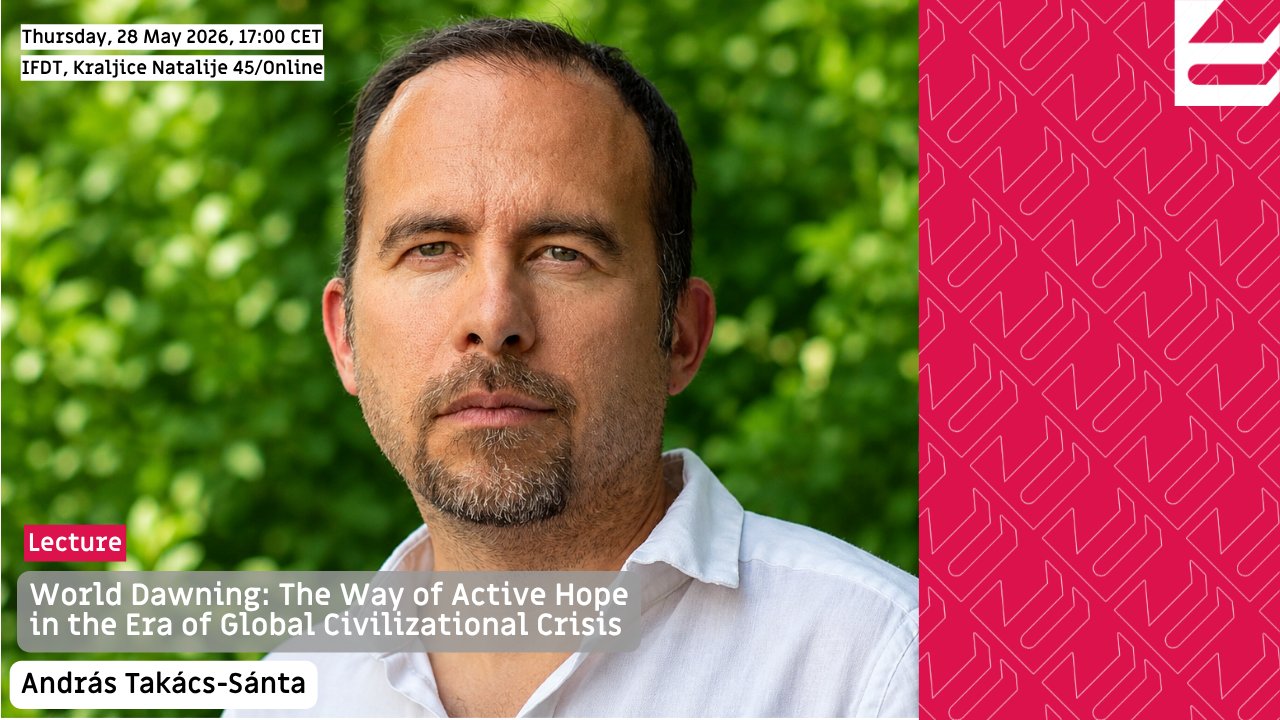
[Lecture] World Dawning: The Way of Active Hope in the Era of Global Civilizational Crisis – András Takács-Sánta (Environmental Studies)
We live in a mythical time, unprecedented in human history, an era of environmental crisis that deepens year by year. Moreover, this is not the only symptom of the ever-worsening crisis of our global consumerist civilization, even if it is perhaps the most important. Still, several thinkers hold to the view that we are marching towards a bright techno-future, and that we should therefore leave the foundations of our civilization intact. Others, however, are convinced that we are doomed, and an age of diminished human existence is soon to come, leaving us with nothing but adaptation.
Those of us who find both of these lines of thinking frightening and deeply troubling should search for a third way. A promising one is the way of active hope. The starting point of this approach is that nobody knows the future, but everybody shapes it. It also involves reclaiming power from states and large corporations and placing it back into the hands of people. Moreover, coordinated action by these people is essential, and the organization of many local groups and broader networks seems to be pivotal for creating new social institutions.
At the same time, we must redefine what a good and meaningful human life means, and rethink our most important values and basic beliefs about the world. In other words, new institutions and a new mindset are needed as the foundation of a new civilization.
The way of active hope is a demanding and arduous path, a herculean endeavor, but we can be sure that there is no easy way out of today’s civilizational crisis. It might also be our only way out.
The program is realized with support of Heinrich Böll Foundation.
András Takács-Sánta is a human ecologist, an associate professor at the Eötvös Loránd University, Faculty of Social Sciences, Budapest, Hungary. He has been dealing with the environmental crisis (and the broader civilizational crisis) from several perspectives for nearly thirty years. In his work, he sees the crisis not only as a major threat but also as a great opportunity for us to discover meaningful human life. Besides being a researcher and thinker, he also helps local eco-communities.