



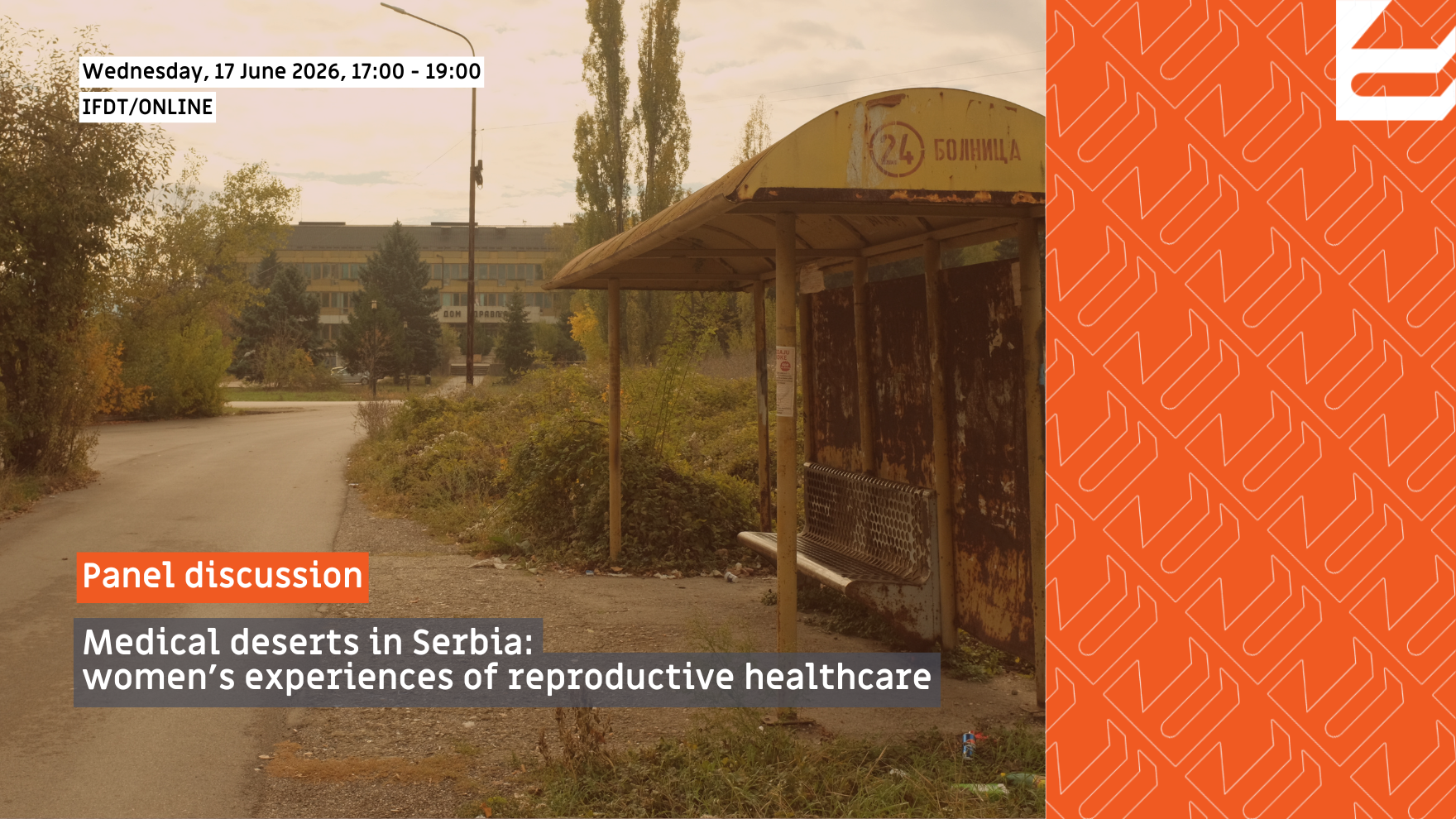
[Panel discussion] Medical deserts in Serbia: women’s experiences of reproductive healthcare (SolidCareLab, PerspectLab)
Women in Serbia have the right to reproductive healthcare. But is it truly within their reach?
The WARM project — Women’s Access to Reproductive Care in Medically Underserved Areas — sets out to answer this question. The research was implemented by the Institute for Philosophy and Social Theory (IFDT), University of Belgrade, with the support of the OSCE Mission to Serbia, as part of the project Promoting Gender Equality through Research on Access to Reproductive Care and Education on Gender-Based Stereotypes.
Although Serbia formally guarantees reproductive and maternal care through universal health coverage, the research shows that these guarantees are not evenly translated into real, continuous care for women who live far from urban centers, depend on fragile transport networks, or experience poverty and discrimination. In these areas, services exist in laws and organizational charts, but women encounter them as distant, fragmented, unpredictable and sometimes unsafe. This gap is what the project terms maternal and reproductive deserts.
Combining desk research with qualitative ethnographic fieldwork in villages around Zajecar and Kikinda, the study conducted fourteen in-depth narrative interviews with women aged 19 to 74. The findings are organized around four interconnected themes: institutional and organizational barriers to care, respectful maternal care, discrimination and unequal treatment, and Roma women’s experiences of reproductive and maternal services.
The panel will present the study’s key findings and recommendations addressed to decision-makers at national, regional and local level.
Research team
Dr Ljiljana Pantović, Institute for Philosophy and Social Theory, University of Belgrade
Dr Sara Nikolić, Institute for Philosophy and Social Theory, University of Belgrade
Dr Jelena Ćeriman, Institute for Philosophy and Social Theory, University of Belgrade
Dr Ivan Đorđević, Institute of Ethnography, Serbian Academy of Sciences and Arts (SASA)