



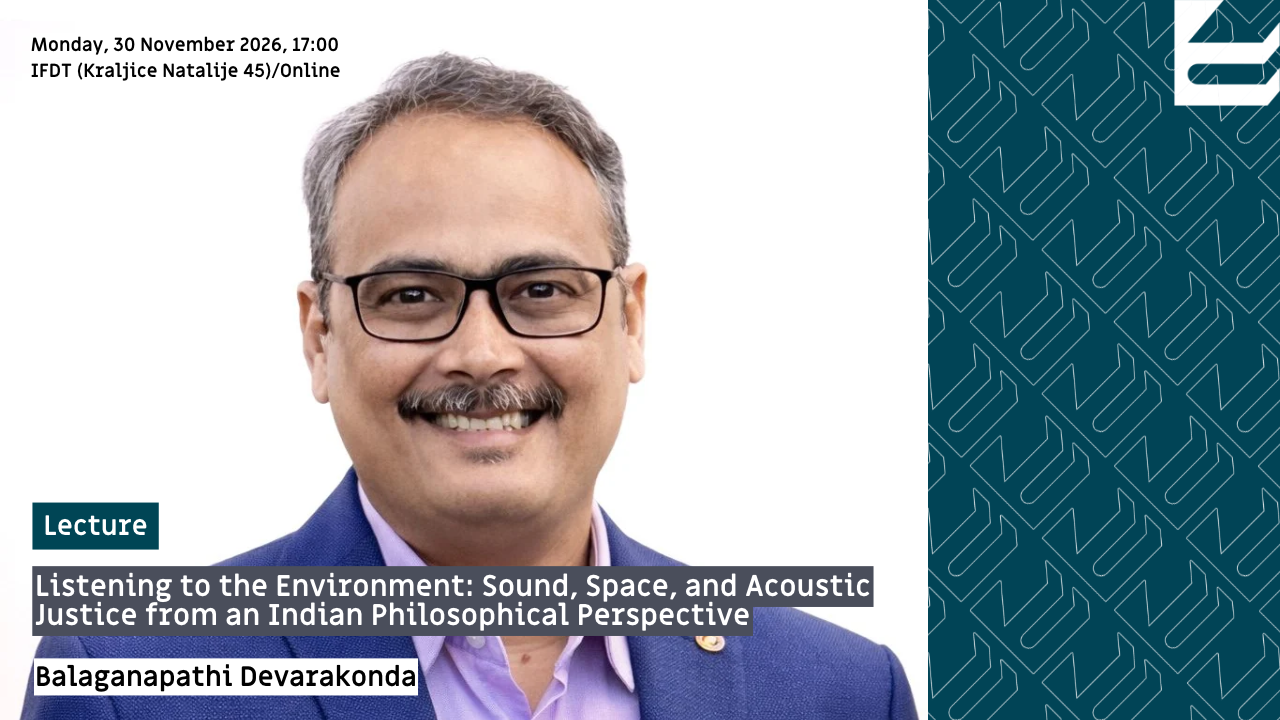
[Lecture] Listening to the Environment: Sound, Space, and Acoustic Justice from an Indian Philosophical Perspective (Environmental Studies Research Group)
The lecture “Listening to the Environment: Sound, Space, and Acoustic Justice from an Indian Philosophical Perspective” explores the relationship between sound, listening, and the experience of the environment, asking how sonic environments shape the ways in which we experience, inhabit, and share space. Contemporary discussions of acoustic justice have largely focused on noise pollution, unequal exposure to harmful sound, and the social distribution of its consequences. This lecture broadens that framework by considering sound not only as a factor affecting environmental quality, but also as a dimension through which human experience, social relations, and shared living spaces are constituted.
Bringing contemporary approaches to acoustic and environmental justice into dialogue with Indian philosophical traditions, the lecture considers insights from the Upaniṣads, the Bhagavad Gītā, Patañjali’s Yoga Sūtras, and the traditions of Mīmāṃsā, Vedānta, and Nāda Yoga. Particular attention is given to the concepts of śabda (meaningful sound), nāda (resonance), and vāk (speech as a world-forming force), approached as conceptual resources for understanding sound as an embodied, relational, and ecological phenomenon.
From this perspective, sound is not merely something located in space; it also participates in shaping it. Sonic environments influence attention, affective experience, social relations, and forms of collective life. Acoustic justice, therefore, concerns not only protection from harmful noise, but also the possibility of creating inhabitable sonic environments that support dignity, attunement, coexistence, and human flourishing.
The lecture invites reflection on acoustic justice beyond the framework of protection from noise pollution, connecting listening to broader questions of ecological vulnerability, social inequality, and the ethics of shared space. By bringing Indian philosophical perspectives into contemporary ecological debates, it also contributes to expanding the conceptual frameworks through which the relationship between human beings, sound, and the environment can be understood.
Prof. Balaganapathi Devarakonda, PhD, is a Professor of Philosophy at the University of Delhi where he until recently served as Head of the Department of Philosophy. He previously held the Indian Council for Cultural Relations (ICCR) Chair in Indology and Gandhian Studies in Jamaica. His research spans Indian philosophy, Buddhism, and philosophical practice.
He is an elected member of the Steering Committee of the International Federation of Philosophical Societies (FISP), a board member of the Association for Philosophy and Counseling (APPA) in New York, and the founding director of the Philosophical Practitioners Association of India. He also holds advisory roles with the Council for Research in Values and Philosophy (Washington, DC) and the EU-funded VERITY project.