



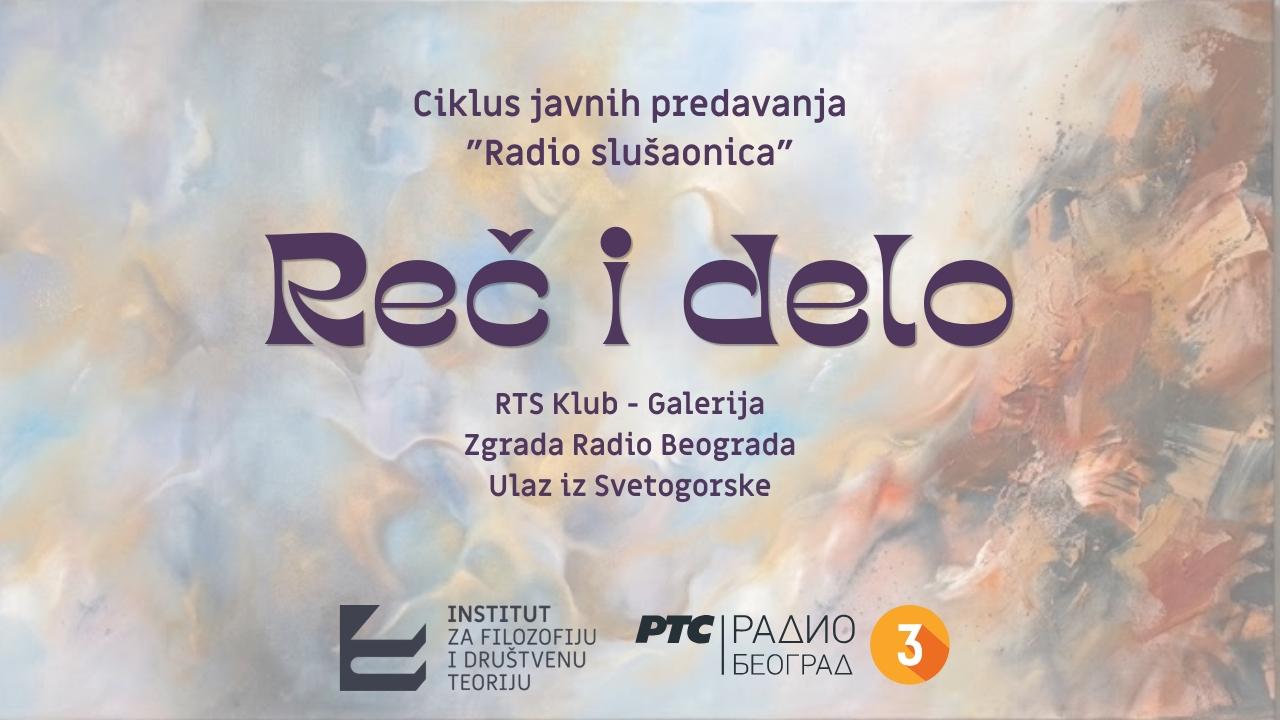
Radio Belgrade Programme Three and the Institute for Philosophy and Social Theory are launching a series of public radio lectures, a format with a distinguished academic and media tradition, under the umbrella title “Word and Deed.”
The aim of the series is to revisit the longstanding question of the relationship between thinking (as well as writing and speaking) and acting; between theory and practice. This dilemma, dichotomy, or perhaps the absence of such a divide, will be explored by distinguished philosophers, sociologists, linguists, anthropologists, and scholars from other fields in the humanities and social sciences who have encountered and reflected upon it in their work. Drawing on their respective areas of expertise and theoretical orientations, speakers will frame and emphasize different aspects of the topic. The lectures will take place on the last Tuesday of every month at 8:00 p.m. in the Radio Belgrade Gallery on Svetogorska Street. They are open to the public and broadcast live on Radio Belgrade Programme Three.
The inaugural lecture, entitled “Word and Deed: Variations,” will be delivered by Predrag Krstić on 27 October. Offering a synoptic historical overview, the lecture will examine debates concerning the primacy of one or the other, from “biblical times” to contemporary controversies. The emphasis placed on word or deed, discourse or action, has both reflected and shaped epochal cultural transformations. In this way, intellectual history has been intertwined with social history. Yet even this observation does not go far enough, since the same question has repeatedly resurfaced, often under different names: which should take precedence? Is action constitutive of theory, or does reflection precede practice? And is a normative commitment already built into that choice, however strongly it may present itself as a matter of “pure” description? Furthermore, do attempts to chart a middle course, reconcile the alternatives, or dismiss the opposition as false actually resolve the problem, or merely dissolve it? The answers to these questions have not only testified, and continue to testify, to shifts in academic interests and the focal points of intellectual debate; they have also had consequences beyond the realm of theory itself.