



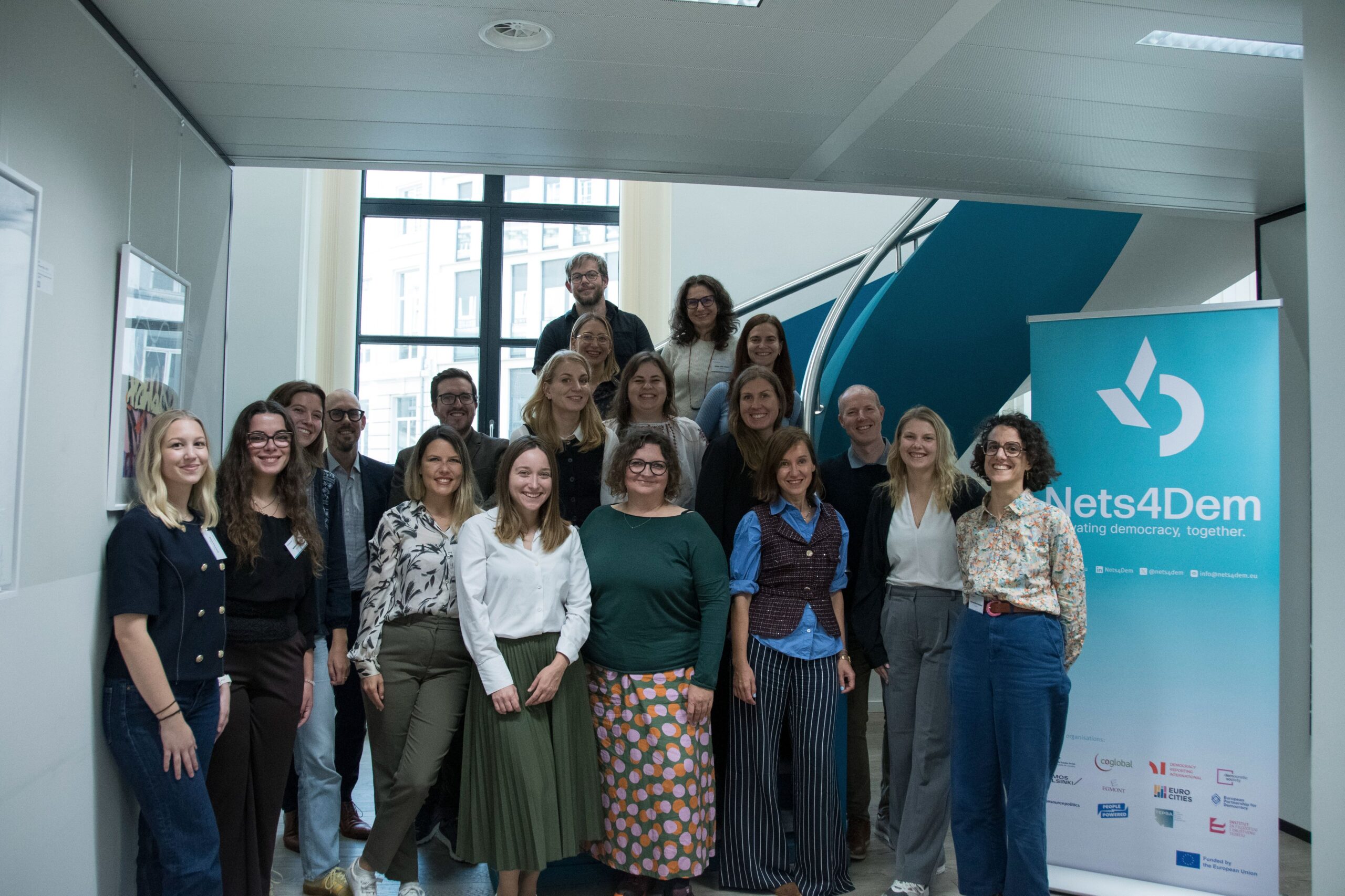
Researchers from IFDT, Tara Tepavac and Ivana Milićević, took part in a kick-off meeting of a new phase of the project Nets4Dem: Network of Networks for Democracy, held in Brussels from 14 to 16 October.
The project brings together networks of cities, public institutions, universities, research centres and civil society organisations from across Europe. Its aim is to develop a “network of networks” – a space for knowledge exchange, collaboration and the development of new approaches to democratic innovation and citizen participation.
One of the key challenges addressed by the project is connecting fragmented knowledge on democratic innovation, scattered across various publications, research studies, databases, institutions and practical experiences, while deepening understanding of democratic innovation in underrepresented fields, geographical areas and socio-political contexts.
IFDT is coordinating project activities aimed at connecting and systematising knowledge on democratic innovation, building on the results of the first iteration of the project. Over the next three years, the Institute’s research team will work on expanding the Democratic Knowledge Database developed during the first phase of the project, coordinating thematic research groups, and developing the concept of a Living Library, which will connect existing knowledge databases and research platforms. Particular attention will be paid to experiences from societies where democratic institutions have been weakened or are under pressure.
During the three-day meeting in Brussels, the partners discussed research priorities, opportunities for further collaboration, and strategic directions for the next three years. Shared goal is to make knowledge about democratic innovation more accessible, better connected, and more useful to researchers, policymakers, and organisations working on strengthening democracy.
More information on the project can be found here.
Funded by the European Union. Views and opinions expressed are those of the author(s) only and do not necessarily reflect those of the European Union or European Research Executive Agency. Neither the European Union nor the granting authority can be held responsible for them.