



Technological futures are not given. They are made, and they can be made differently. EMERGE 2026: Contested Futures takes place at a moment when AI systems have become central to the organization of economic power, political control, and social sorting, while democratic institutions struggle to keep pace and ecological costs mount. Rather than treating technological change as inevitable or neutral, the conference invites critical reflection on how emerging technologies are developed, governed, narrated, and contested.
As AI and digital infrastructures become increasingly embedded in everyday life, they reshape democratic processes, social relations, environmental conditions, education, design, media, and cultural production. These futures are shaped not only by technical innovation, but also by struggles over labor, resources, values, knowledge, and social organization. EMERGE 2026 therefore asks what is at stake, but also what is already being done, by whom, under which conditions, and what alternatives are being built, demanded, and practiced.
At the core of this year’s conference are several guiding questions. How are AI and emerging technologies reshaping power, governance, and public life? What forms of inequality, exclusion, and extraction do they reproduce, intensify, or obscure? How are technological futures narrated, legitimized, and contested across media, culture, platforms, and everyday life?
These questions extend to emerging methods, practices, and alternatives. How is synthetic research, understood as the use of AI-generated data, personas, and simulations to model human behavior, being used across disciplines, and what risks arise when its findings inform decision-making processes? What kinds of critical, speculative, and practice-based approaches might help us reimagine and enact more just, democratic, and sustainable alternatives? What alternatives are already being imagined, built, practiced, and defended, and whose work makes them possible?
EMERGE 2026 welcomes interdisciplinary contributions that critically examine dominant technological paradigms and engage with resistant, alternative, and transformative approaches. Submissions may come from philosophy, sociology, political theory, media and communication studies, cultural studies, art theory, education, design, computer science, and related disciplines, exploring how digital futures are shaped, contested, and reimagined. Contributions grounded in case studies, action research, policy analysis, and practice-based inquiry are especially welcome alongside theoretical and empirical work.
Topics include, but are not limited to:
- Digital democracy, governance, and technological power
- AI ethics, justice, and social inequality
- Environment, extraction, sustainability, and digital degrowth
- Art, culture, and critical AI practices
- Agency, resistance, and subjectivity in the age of AI
- Education, AI-assisted learning, and digital literacy
- Media and communication: platforms, algorithms, and technological imaginaries
- Synthetic research: methods, risks, and epistemic challenges
- Human-machine communication: power, design, and human-AI relations
- Speculative and alternative technological futures
The 2026 edition is co-organized by the Digital Society Lab of the Institute for Philosophy and Social Theory, University of Belgrade and the Institute for Artificial Intelligence Research and Development of Serbia.
EMERGE is an event organized by the Digital Society Lab of the Institute for Philosophy and Social Theory, University of Belgrade, dedicated to exploring the social, ethical, political, environmental, and cultural implications of artificial intelligence and emerging technologies. Combining an annual forum with a biannual academic conference, it brings together scholars, researchers, artists, policymakers, and practitioners for critical interdisciplinary exchange.
Keynote Speakers: TBA
Submission Guidelines
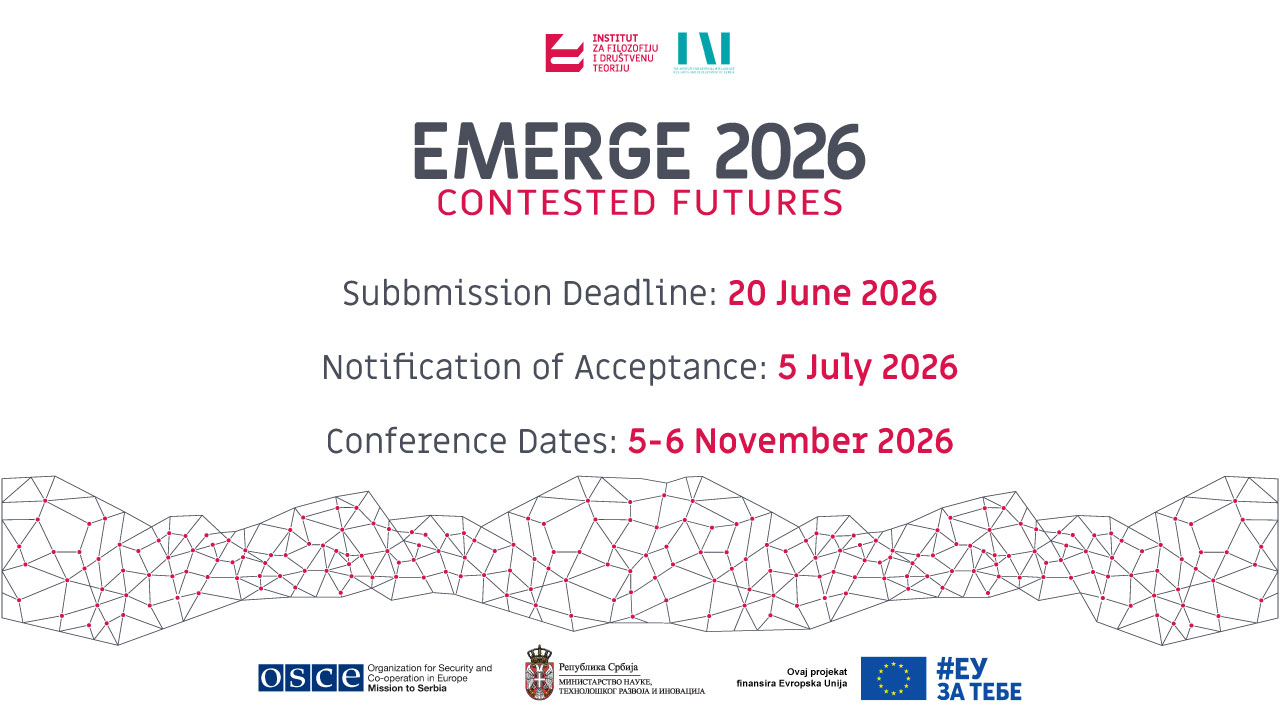
All abstracts must be submitted exclusively through the abstract submission form available here. The submission deadline is 5 June 2026. Each submission should include:
- Title
- Abstract (500–600 words)
- 3–5 keywords
- Name, current position, affiliation, email address, and a short biography (no more than 200 words) of all authors
Authors are required to use the provided abstract template. For any inquiries regarding the submission process, please contact: emerge@ifdt.bg.ac.rs
Venue:
Institute for Philosophy and Social Theory, University of Belgrade
Kraljice Natalije 45, 4th Floor
Belgrade, Serbia
Fees:
Conference fee: There are no participation fees for this conference. Participants are kindly requested to cover their own travel and accommodation expenses.
Conference dinner fee (optional): 40 EUR.
Contact:
For more information, please contact us at emerge@ifdt.bg.ac.rs
We look forward to your submissions and to the conversations EMERGE 2026 will open.
Committees:
Steering Committee
- Ljubiša Bojić (Chair), Institute for Philosophy and Social Theory, University of Belgrade and Institute for Artificial Intelligence Research and Development of Serbia
- Jelena Guga, Institute for Philosophy and Social Theory, University of Belgrade
- Simona Žikić, Institute for Philosophy and Social Theory, University of Belgrade and Faculty of Media and Communications, Singidunum University
- Čedomir Markov, Institute for Philosophy and Social Theory, University of Belgrade
- Jörg Matthes, Department of Communication, University of Vienna
- Achim Rettinger, Knowledge Representation Learning (krAil) Research Group, Trier University
- Damian Trilling, Faculty of Social and Behavioral Sciences, Vrije University Amsterdam
- Sedat Uçar, Faculty of Education, Çukurova University
- Srđan Dušanić, Faculty of Philosophy, University of Banja Luka
- Ernest Ženko, Department of Media Studies, University of Primorska
- Mark Coeckelbergh, Department of Philosophy, University of Vienna
- Marina Dabić, Faculty of Economics and Business, University of Zagreb
- James O’Higgins Norman, DCU Institute of Education, Dublin City University
- Amalee Meehan, School of Human Development, Dublin City University
- Alexander Felfernig, Institute of Software Engineering and Artificial Intelligence, Graz University of Technology
- Mihaela Rus, Faculty of Law and Administrative Sciences, Ovidius University of Constanța
Scientific Committee
- Jelena Guga (Chair), Institute for Philosophy and Social Theory, University of Belgrade
- Ljubiša Bojić, Institute for Philosophy and Social Theory, University of Belgrade and Institute for Artificial Intelligence Research and Development of Serbia
- Simona Žikić, Institute for Philosophy and Social Theory, University of Belgrade and Faculty of Media and Communications, Singidunum University
- Čedomir Markov, Institute for Philosophy and Social Theory, University of Belgrade
- Željko Radinković, Institute for Philosophy and Social Theory, University of Belgrade
- Zoran Erić, Institute for Philosophy and Social Theory, University of Belgrade
- Vera Mevorah, Institute for Philosophy and Social Theory, University of Belgrade
- Ivana Krtolica, Institute for Artificial Intelligence Research and Development of Serbia
- Veljko Prodanović, Institute for Artificial Intelligence Research and Development of Serbia
- Sanja Bojanić, Center for Advanced Studies Southeast Europe, University of Rijeka
- Emanuele Arielli, Department of Project Cultures, IUAV University of Venice
- Aleksandra Kanjuo-Mrčela, Faculty of Social Sciences, University of Ljubljana
- Achim Rettinger, Knowledge Representation Learning (krAil) Research Group, Trier University
- Damian Trilling, Faculty of Social and Behavioral Sciences, Vrije University Amsterdam
- Jörg Matthes, Department of Communication, University of Vienna
- Matteo Cinelli, Department of Computer Science, Sapienza University of Rome
- James O’Higgins Norman, DCU Institute of Education, Dublin City University
- Amalee Meehan, School of Human Development, Dublin City University
- Ana Martinoli, Faculty of Dramatic Arts, University of Belgrade
- Bojana Romić, School of Arts and Communication (K3), Malmö University
- Luka Perušić, Faculty of Philosophy, University of Zagreb
- Tamara Kunić, VERN’ University
- Aleksandra Krstić, Faculty of Political Science, University of Belgrade
- Zorana Jolić Marjanović, Faculty of Philosophy, University of Belgrade
- Bojana Dinić, Faculty of Philosophy, University of Novi Sad
- Damien Guzek, Faculty of Social Sciences, University of Silesia in Katowice
- Florian Röhrbein, Faculty of Computer Science, Chemnitz University of Technology
- Aleksandar Tomašević, Institute of Physics Belgrade, University of Belgrade
- Irena Stojković, Faculty of Special Education and Rehabilitation, University of Belgrade
- Milan Čabarkapa, Faculty of Engineering Sciences, University of Kragujevac
- Boris Delibašić, Faculty of Organizational Sciences, University of Belgrade
- Olga Zagovora, Department of Psychology, RPTU University Kaiserslautern-Landau
Organizing Committee
- Zoran Erić (Chair), Institute for Philosophy and Social Theory, University of Belgrade
- Jelena Novaković, Institute for Philosophy and Social Theory, University of Belgrade
- Simona Žikić, Institute for Philosophy and Social Theory, University of Belgrade and Faculty of Media and Communications, Singidunum University
- Tijana Uzelac, Institute for Philosophy and Social Theory, University of Belgrade
- Jelena Guga, Institute for Philosophy and Social Theory, University of Belgrade
- Ljubiša Bojić, Institute for Philosophy and Social Theory, University of Belgrade and Institute for Artificial Intelligence Research and Development of Serbia