



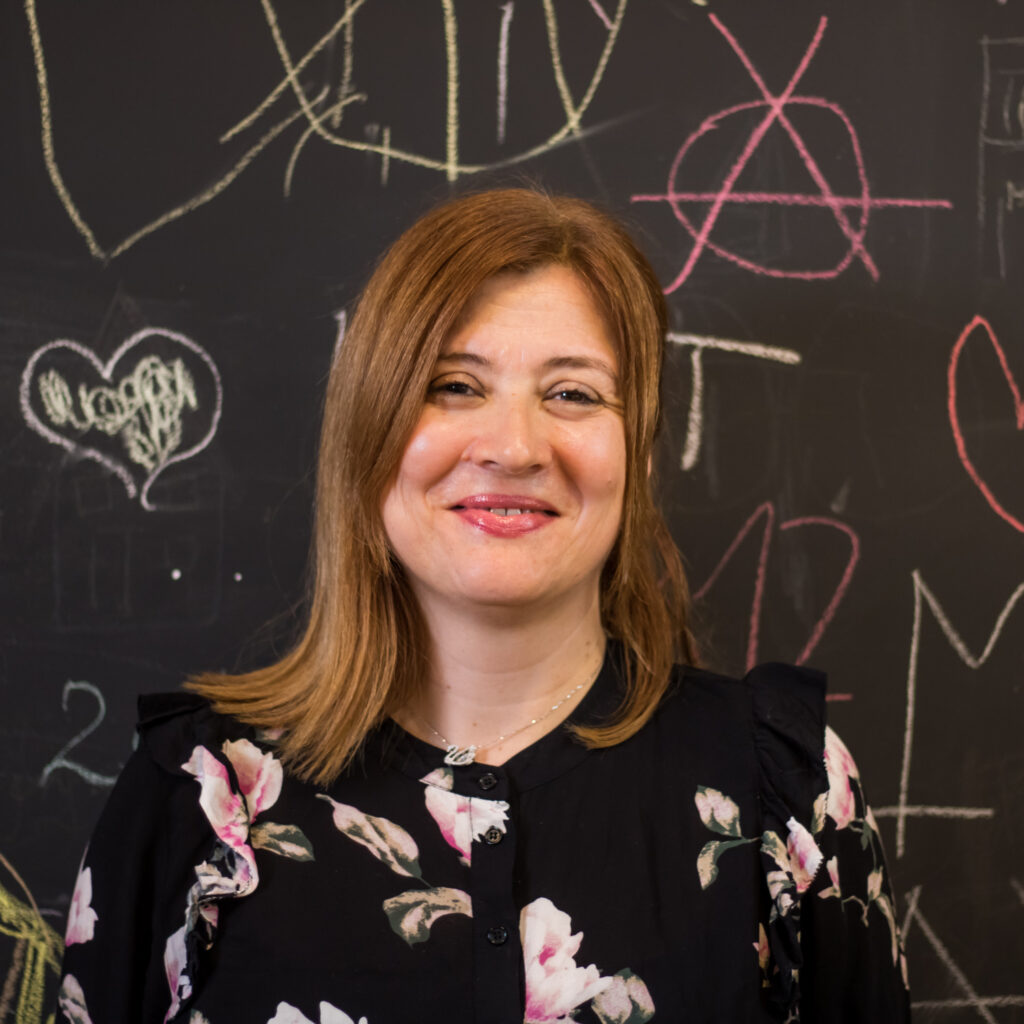
Mandić Marija
- (2010) PhD, Linguistics, Faculty of Philology, University of Belgrade
- (2004) Magister degree, Linguistics, Faculty of Philology, University of Belgrade
- (1998) Bachelor’s degree, Philology, Serbian language and literature, Faculty of Philology, University of Belgrade
Marija Mandić is a senior research fellow at the Institute for Philosophy and Social Theory, University of Belgrade. She was previously employed at the Institute for Balkan Studies of the Serbian Academy of Sciences and Arts (2004–2022) and the Institute for the Serbian Language Studies of the Serbian Academy of Sciences and Arts (1999–2000). She won numerous scholarships for scientific training and research, including the Humboldt Research Scholarship for Postdoctoral Fellows (2016–2018), which she received while serving as a visiting scholar at the Institute for Slavic and Hungarian Studies at Humboldt University in Berlin. Marija Mandić has been a leader or associate on many international and national scientific projects. Currently, she is involved in the project “Imagining a Nation: The Contesting Serbian National Narratives (XX-XXI century) – IMAGINATION” (The Science Fund of the Republic of Serbia; #7422; 2024-2027). She has conducted continuous qualitative ethnographic and linguistic field research in Serbia, Hungary, Germany, and other locations. She has given guest lectures at the University of Belgrade, the University of Kragujevac, the Central European University, the University of Vienna, Humboldt University in Berlin, the University of Oslo, and the University of Tirana, among others. She has been a coordinator and director at the Course on the Balkans, Invisible University for Ukraine, and Central European University in the years 2023/2024, 2024/2025, and 2025/2026. Her primary research interests include sociolinguistics, critical discourse studies, linguistic anthropology, the relation between discourse and social identity (ethnic, national, gender), minority languages of Southeastern Europe, social memory, Ottoman heritage, and cultural trauma. She published and edited several books and studies in the fields above, including Discourse and Ethnic Identity: The Case Study of Serbs in Hungary, Munich: Peter Lang (2014), Manjinski jezici u Vojvodini: obrazovna jezička politika, ideologija i praksa [Minority Languages in Vojvodina: Educational Language Policy, Ideology and Practice], Novi Sad: Akademska knjiga, (2024).
Latest publications
- Mandić, M. 2025. “Learning the neighbour’s language: Regional and minoritized languages as a resource in the European educational context”. In W. Weixiao & J. Schnell (Eds), The Routledge Handbook of Endangered and Minority Languages, 259–273. Routledge.
- Mandić M. (Ed.) 2024. Manjinski jezici u Vojvodini: obrazovna jezička politika, ideologija i praksa [Minority Languages in Vojvodina: Language Education Policy, Ideology and Practice]. Novi Sad: Akademska knjiga.
- Mandić, M. & N. Rebronja 2024. “Deosmanizacija i posvojenje: kritičko preispitivanje osmanskog nasleđa u srpskoj kulturi i književnosti” [De-Ottomanisation and Internalisation: A Critical Analysis of the Ottoman Heritage in Serbian Culture and Literature], Special Issue: “Muslimanske teme u srpskoj književnosti II” [Muslim Topics in Serbian Literature II], M. Mandić & N. Rebronja (Eds). Književna istorija — časopis za nauku o književnosti, 56 (182): 91–127.
- Mandić, M. & K. Rácz 2023. “Learning the language of social environment: the case of Hungarian in Vojvodina (Serbia)”. Current Issues in Language Planning, 24 (4): 460–480.
- Vervaet S. & M. Mandić. 2022. “Mapping Minority Multilingualism: Perspectives from Central and South-Eastern European Borderlands – Introduction to the Thematic Issue”. Special Issue: “Mapping Multilingualism on the Periphery: Perspectives from Central and South-Eastern European Contact Zones”, S. Vervaet S. & M. Mandić (Eds). Zeitschrift für Slawistik, 67 (4): 501–510.