



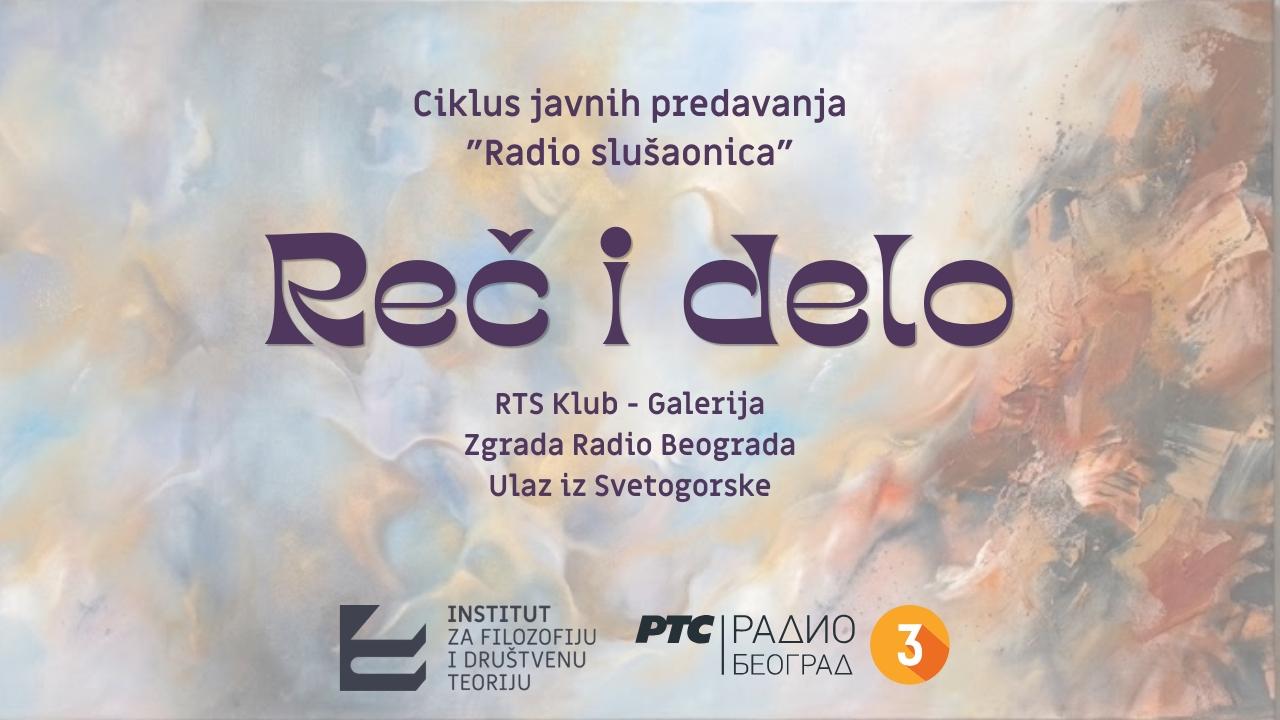
Public Lecture Series “Word and Deed”
Lecture entitled “Speaking against the social structure: how to engage our inner contradictions?” will be held by Marjan Ivković, senior research associate at the Institute for Philosophy and Social Theory.
Radio Belgrade Programme Three and the Institute for Philosophy and Social Theory are launching a series of public radio lectures, a format with a distinguished academic and media tradition, under the umbrella title “Word and Deed.” The aim of the series is to revisit the longstanding question of the relationship between thinking (as well as writing and speaking) and acting; between theory and practice. This dilemma, dichotomy, or perhaps the absence of such a divide, will be explored by distinguished philosophers, sociologists, linguists, anthropologists, and scholars from other fields in the humanities and social sciences who have encountered and reflected upon it in their work. Drawing on their respective areas of expertise and theoretical orientations, speakers will frame and emphasize different aspects of the topic. The lectures will take place on the last Tuesday of every month at 8:00 p.m. in the Radio Belgrade Gallery on Svetogorska Street. They are open to the public and broadcast live on Radio Belgrade Programme Three.
This Tuesday, Marjan Ivković asks a question can we encourage people to question themselves and act socially, solely with speech, without imposing ready-made answers on them? The lecture discusses the possibility of non-authoritarian and non-paternalistic “changing people for the better” through mobilizing the emancipatory aspects of their internal contradictions. Relying on the notions of non-identity, chains of equivalence, pseudo-concreteness and the communicative mind, we will try to explain why modern subjects are imbued with contradictions in their self-concept and relationship to the world. Examples from local and global everyday life will show how precisely these contradictions can be turned into an incentive for self-reflection and social engagement. A complex theoretical language is not necessary for such action: it is enough to develop “transversal” forms of everyday speech that strengthen our inner “better halves”.