



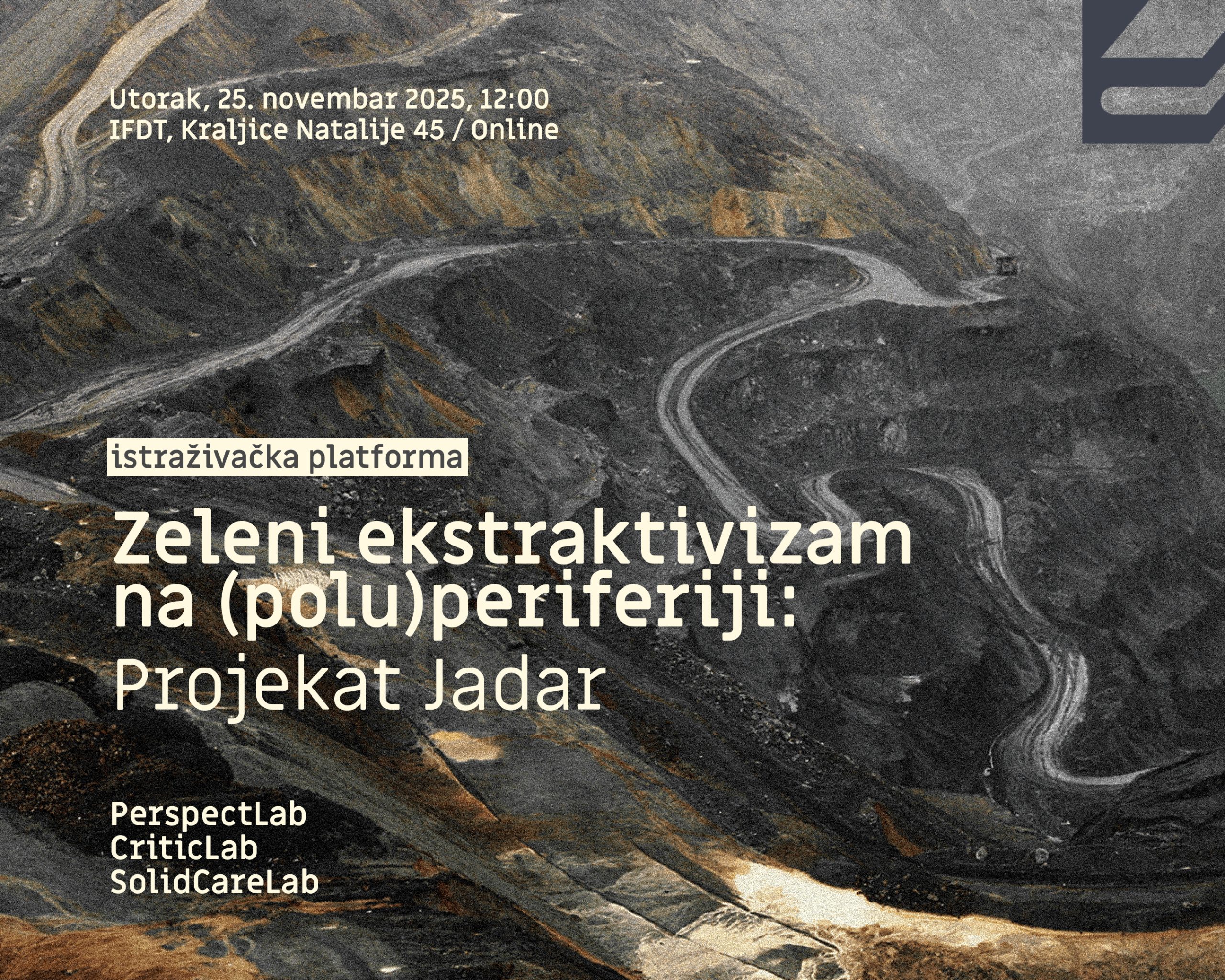
[Research platform] Green Extractivism on the (Semi)Periphery: The Jadar Project (PerspectLab, CriticLab, SolidCareLab)
The 2023 European Critical Raw Materials Act underscores the EU’s commitment to securing key resources, such as lithium and copper, necessary for achieving the carbon neutrality goals of the European Green Deal. Framed as a step toward EU autonomy through “local” extraction, this policy has encouraged speculative mining projects, particularly across Eastern Europe. While presented as opportunities for economic revitalization, such projects raise numerous environmental concerns, financial uncertainties, and long-term risks associated with fluctuating raw material demand. Crucial questions arise: whose visions guide these projects? Who benefits, and who bears the consequences? What conflicts emerge, and how are mining futures negotiated and contested on the (semi)periphery?
In Serbia, these questions have become central to public debate due to widespread opposition to the proposed Rio Tinto lithium mine in the Jadar River valley. Initiated through exploratory permits as early as 2004, the project faced massive public resistance, culminating in one of the largest protest movements in Serbia’s recent history. Tens of thousands of people took to the streets, opposing a mining venture that could devastate a densely populated and agriculturally rich region. Unlike typical lithium deposits located in sparsely inhabited, semi-arid areas, Jadar’s unique context amplifies fears of long-term health hazards, damage to food production, and the destruction of local communities.
The struggle against Rio Tinto has come to symbolize resistance to a neocolonial dynamic in which the EU’s “green transition” relies on the exploitation of resources from (semi)peripheral societies such as Serbia. Multinational corporations and political elites align their interests, turning entire regions into “sacrifice zones” in the name of sustaining capitalist growth, social stratification, and widening global inequalities under the guise of ecological progress. The anti-lithium movement in Serbia articulates an anti-colonial narrative that rejects the exploitation of the (semi)periphery for the benefit of the center and challenges the dominant development model based on foreign investment.
This event explores these tensions by critically examining the role of lithium extraction in reproducing power relations and by reflecting on alternatives for more sustainable and just futures. It aims to initiate the creation of a platform for researchers in the social sciences and humanities who study, or wish to study, extractivism and support local communities in their struggles in Serbia.
PROGRAM
12:00 – 14:30
Whose Security? The Military–Digital–Energy Transition on the (Semi)Periphery
Sofija Stefanović (University of Cambridge, Department of Computer Science and Technology)
Two Faces of Displacement: Physical Relocation and Environmental Destruction in the Jadar Valley
Ana Vilenica (University of Belgrade, Institute for Philosophy and Social Theory & Södertörn University, Stockholm) and Vladimir Mentus (Institute of Social Sciences)
Coffee Break
15:00 – 17:30
Between Center and Periphery: What Do EU Strategic Projects Mean for Resistance in Serbia
Nina Đukanović (University of Oxford, School of Geography and the Environment)
Green Extractivism and Strategies of Resistance
Mina Petrović (University of Belgrade, Faculty of Philosophy) and Jelena Pešić (University of Belgrade, Faculty of Philosophy)
Moderation: Sara Nikolić (University of Belgrade, Institute for Philosophy and Social Theory), Dušanka Milosavljević (University of Belgrade, Institute for Philosophy and Social Theory) and Ana Vilenica (University of Belgrade, Institute for Philosophy and Social Theory)