[Reading workshops] Is the philosophy of science a socially engaged discipline?
Participation is possible for all interested regardless of their level of study, philosophical or scientific discipline which they come from.
The Institute’s roots reach back to the establishment of the Center for Philosophy and Social Theory within the Institute of Social Sciences in 1981, the new home, as it were, of a group of professors expelled from the university in 1975.
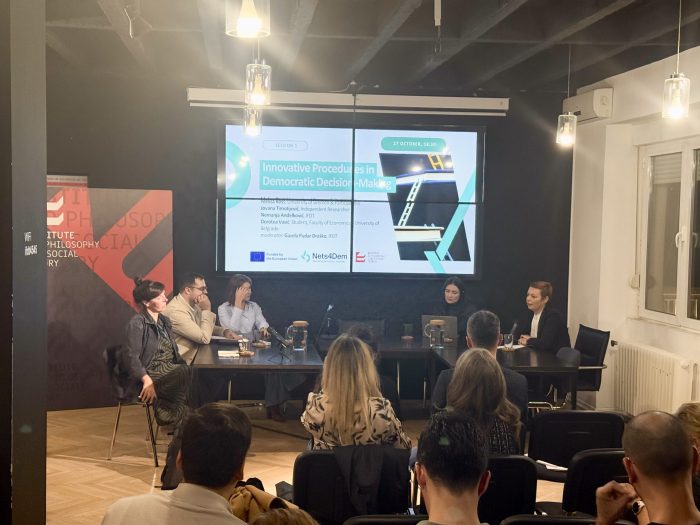
Call for papers; Revitalizing democracy through participatory democratic innovations; Jean Monnet Network Final Conference
This issue of Philosophy and Society features a thematic section entitled PIERRE BOURDIEU: THEORY AND PUBLIC ENGAGEMENT as well as original articles on alienation, Hegel, and Diderot; the spiritual and pedagogical sciences…
We would like to single out two thematic units from the current issue: Education and Emancipation and the Crisis of Democracy in the Region of Southeast Europe.
The main aim of the online workshop “Who Cares? Narratives on Families in Postsocialist Europe” has been to gather the participants who are going to actively participate in one of the two main activities of the Working Group on Families and Social Welfare in the months to come.
This international workshop is organized within the framework of COST Action 18119 Who Cares In Europe?, whose aim is to explore the relationships among families, states and voluntary associations in the creation of social welfare in Europe.
Zagorka Golubović was one of the founders of social anthropology in Serbia and decisively influenced the development of the study of sociology and anthropology at the University of Belgrade.
Within the Mapping PhDs in the Diaspora project, organized by the Institute of Philosophy and Social Theory, University of Belgrade